
Forestry · Watershed accountability
After the fire, what kind of forest are we rebuilding?
Native trees, herbicides and public money: agency records reveal a production model—and a missing test of its watershed claims.
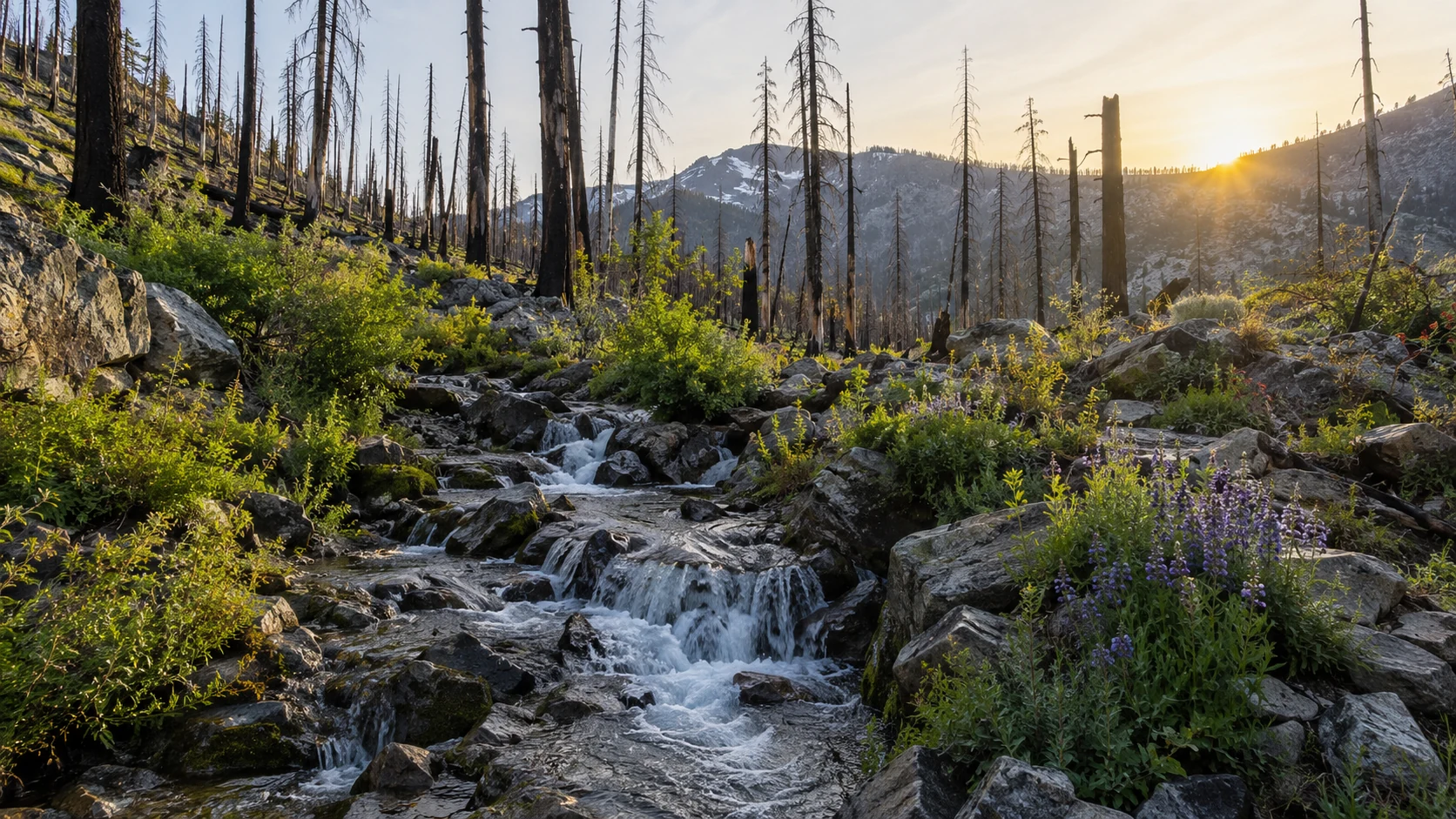
A burned hillside does not stay empty for long. Shrubs resprout. Grasses and wildflowers return. Young hardwoods push up through the damaged ground. To wildlife, that recovering landscape can be food, shelter and habitat. To a forester trying to establish a selected stand of conifers, some of the same plants are competition.
That difference matters. A project can successfully grow planted trees while removing native recovery. It can meet a stocking target without showing that the watershed improved. And it can be described as restoration without telling residents what chemicals were used—or whether those chemicals reached the water below.
California’s forestry agencies and project operators describe their objectives in their own records. Read those records together, and a practical question emerges: are we measuring the recovery of a forest, or the successful establishment of a timber stand?
The production objective is written down
CAL FIRE describes Board policy for demonstration forests in terms of keeping “forest crop land in a productive condition.” Its explanation of state law centers “maximum sustained production of high-quality forest products,” alongside consideration of watershed, wildlife, recreation and other values. The Board’s description of the Forest Practice Act likewise makes productivity and sustained yield explicit. [1–2]
Logging has an important place in California’s economy and history. The issue is whether the public is told plainly what a project is designed to produce, and whether its environmental claims are tested independently of timber growth.
State demonstration forests are one program, not a complete inventory of California’s forests. Federal forests operate under a different, multiple-use mandate. Nor does a “timberland” classification prove that every acre is a plantation. The records document the production approach in real operations; they do not establish its statewide acreage share. [1, 3–5]
“Native” does not answer the restoration question
A tree can be native and still be part of a plantation. Species selection, spacing, shrub control, thinning and eventual harvest determine how a stand is managed. Sierra Pacific Industries describes a business cycle of regeneration, planting, management, harvest and manufacture. A 2019 review by university and Forest Service scientists describes conventional western reforestation as dense conifer planting in grids, followed by vegetation control and thinning, and argues for more varied, resilient approaches. [6–7]
The useful questions are concrete: which plants are kept, which are killed, and how much natural regeneration is accepted? What counts as success—a diverse recovering community, a specified number of surviving conifers, or both?
UC Agriculture and Natural Resources’ March 2026 guidance discusses herbicide “targeting of oaks and shrubs like greenleaf manzanita, tanoak, and chinquapin.” It also discusses controlling Ceanothus and manzanita. These are native plants. This work is not simply the removal of invasive species. [8]
A shrub can compete with a planted pine while providing food and cover for animals. Removing it may increase other native plants; research has documented that outcome too. Plant richness, habitat structure and wildlife use are different measures, and each deserves to be assessed. [8, 24]
This is happening in Lassen and Plumas
Feather River reforestation after the Dixie Fire lists ponderosa pine, Jeffrey pine, Douglas-fir, incense cedar and rust-resistant sugar pine. All five are conifers. Its account says half of participating landowners agreed to a one-time post-planting herbicide application. That is a share of participants, not a share of treated acreage. [9]
On Lassen National Forest, Fall River Resource Conservation District describes herbicide approval for the Bald and Eiler projects after poor seedling survival, and identifies snowbrush regrowth as a challenge. Its Manzanita Chutes description explicitly identifies older pine plantations. [10]
The West Lassen Headwaters decision anticipates 120–200 planted conifers per acre with herbicides, or up to 250 without them to compensate for mortality. Its long-term surviving-tree target is lower. The same decision includes hardwood, aspen, meadow and riparian work, natural regeneration in smaller patches, and removal of some herbicide areas over water concerns. Those differences should be reported alongside the deliberate effort to establish chosen tree stocking. [11]
Public funding for spraying. Where are the water results?
CAL FIRE’s October 9, 2024 site-visit report identifies W.M. Beaty as land manager for visits to Humbug Valley and Cheney Creek under a private-land disaster-recovery agreement. CAL FIRE, the U.S. Forest Service and the California Forestry Association participated. [25]
“Pre-emergent herbicide application is being conducted in conjunction with mastication as site preparation ahead of planting.”
CAL FIRE site-visit report, October 9, 2024 [25]
The report describes planned planting at 150–180 trees per acre and filming about the grant and postfire reforestation. It closes with “No issues or concerns were noted.” But it reports no receiving-water herbicide measurements. A visit can document activities; that closing statement cannot establish that chemicals stayed on the treated land.
This record does not prove that nobody tested elsewhere or identify which particular Motor Sheep acres received reimbursement. It does show why treatment maps, payment records and laboratory reports belong beside publicly funded environmental claims.
A recovering landscape can be valuable before the trees grow
Forest Service scientists White and Long explain that severe fire can restore meadows, shrubfields and open forests with hardwood components in places where conifers expanded through fire suppression. They warn that reforestation in such places can work against ecological function. In other settings, planting can help where seed sources or climate conditions limit recovery. The decision needs a site-specific ecological basis. [12]
Research after the Dixie and Caldor fires found that seeds surviving in cones supported regeneration in some severely burned interiors. The mechanism depended on conditions and was considered an exception, rather than a general rule. It strengthens the case for surveying a site before assuming natural recovery has failed. [13]
A southwest Oregon study found more vegetation cover and bird species in early postfire stands than in intensively managed clearcuts during years two through five. It compared whole management packages, not herbicides alone, and some differences changed with stand age. The lesson is to identify the food, cover and nesting structures being removed, rather than assume planted-tree growth measures every wildlife benefit. [14]
Replanting and reburning need scrutiny
The 2019 reforestation review describes dense young plantations established after the 1987 Stanislaus fires that burned again in the 2013 Rim Fire, with rapid spread, high intensity and complete mortality in many stands. A separate 2025 northern Sierra Nevada study found higher odds of severe fire on private industrial land after accounting for weather and biophysical factors. Neither finding establishes that every plantation behaves alike or isolates the effect of an individual herbicide application. [7, 15]
Evidence also supports prescribed burning and thinning combined with burning as ways to reduce subsequent fire severity. That evidence does not automatically justify every other intervention. Each treatment needs evidence matching its claimed benefit. A plantation fire remains a wildfire; public reporting should also disclose the management history of the land that burned. [16–17]
More trees are not a water-quality measurement
Research in Yosemite’s Illilouette Creek Basin found that decades of managed wildfire produced a more open landscape, with wetter conditions in some areas that became meadow. A wider review of western forest studies found that water responses to disturbance varied: streamflow and snowpack could rise, fall or remain unchanged. Conditions and returning vegetation matter. [18–19]
Water quantity, seasonal flow, temperature, sediment and herbicide contamination are separate outcomes. An erosion inspection cannot tell us which herbicide is dissolved in a creek. Counting surviving seedlings cannot do that either.
The state already documented herbicides reaching water
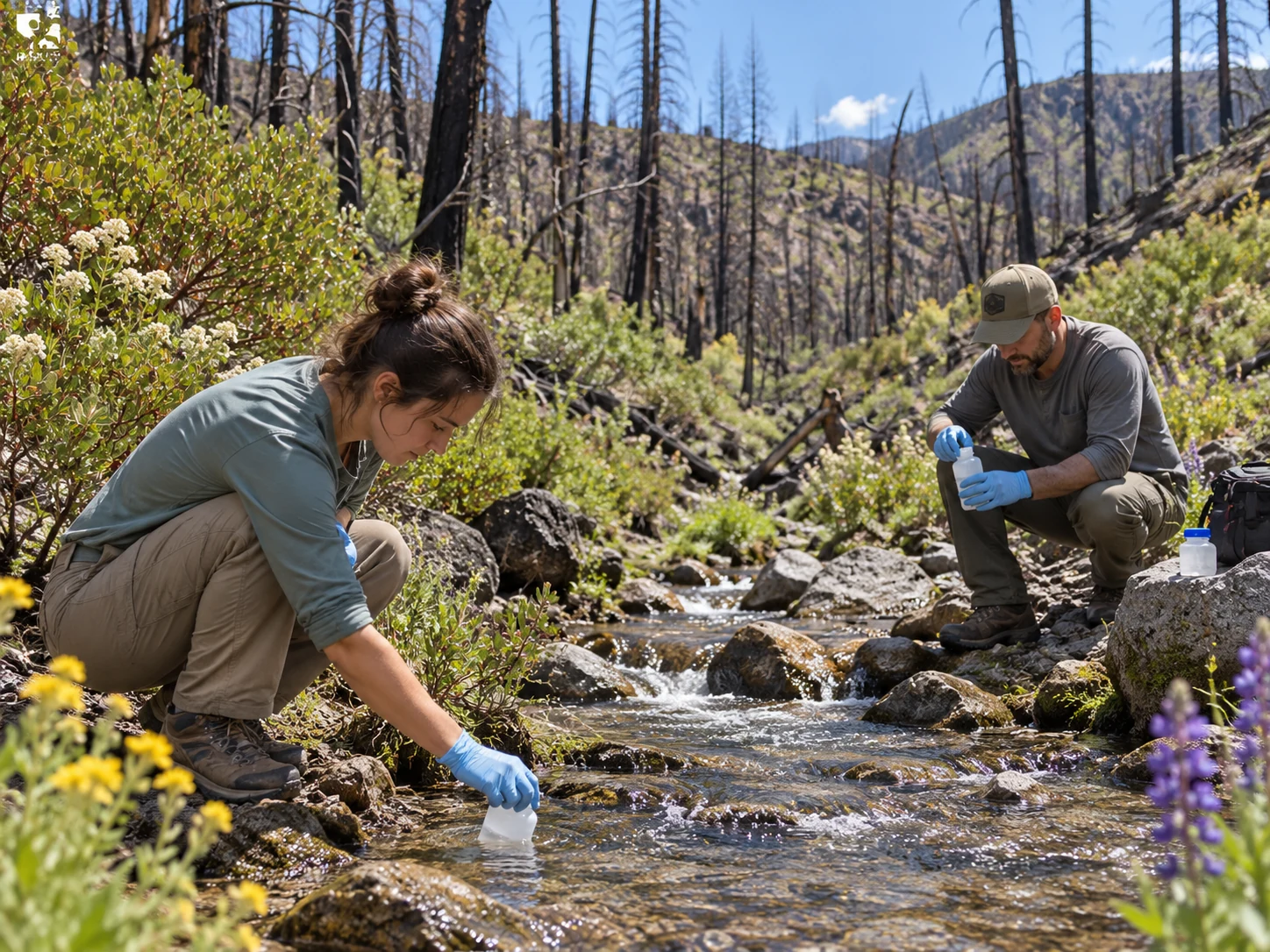
The Central Valley Water Board’s 2017 information sheet records substantial hexazinone use in the Battle Creek watershed, mostly associated with postfire conifer plantation establishment. Its pilot sampling found hexazinone in all 26 samples, along with detections of other herbicides. The work had method and equipment limitations, but it documented a chemical-monitoring problem. [28]
The same document concluded that label instructions and applications had not prevented discharge of specific chemicals in that sampling experience. This was a historical assessment, not a finding about every later application. It is a clear reason to measure what happens downstream.
A proposed test was left out—and the gap remains a public question
UC Davis, working with USGS and the Central Valley Water Board, proposed EMC-2022-001: application-informed sampling for ten herbicides using four approaches, including seasonal events. November 2022 meeting minutes record staff saying all proposals could be funded as requested. The approved package nevertheless omitted 001. The minutes document concerns about its connection to the Forest Practice Rules, alongside support from other members. [21, 27]
The earlier 2021 proposal had a separate history: recommendation followed by withdrawal over indirect-cost limits. Those two decisions should not be collapsed into one. The records establish the funding choices; they do not establish a concealed motive. The unanswered question is what equivalent application-linked monitoring was implemented afterward. [20, 22]
Lahontan’s May 9, 2025 letter acknowledges that its Timber Waiver does not expressly require monitoring groundwater and surface water for herbicides and herbicide mixtures. Its effectiveness-monitoring form emphasizes visual evaluation, erosion and sediment delivery. In the Motor Sheep matter, its later response states that staff did not inspect during project implementation and explains its disputed source-attribution position. [26, 29–30]
DPR does operate environmental-monitoring programs. That fact, or a company’s statement that it monitors water, does not answer whether the relevant chemicals were sampled below a particular forestry application at the relevant time. The answers are in locations, analyte lists, reporting limits and laboratory reports. [6, 23]
Follow the application. Test the water. Publish the evidence.
California Water Monitoring Project’s starting point is practical: obtain the PURs, identify what was applied, prepare a sampling plan, then collect connected runoff and creek-bed sediment during fall rain and spring snowmelt. Each site’s application records determine its tests. Experienced local volunteers can reach remote drainages beyond maintained roads, with access arranged as needed.
We will publish laboratory reports and sample locations alongside application records, including non-detections and reporting limits. When findings warrant complaints, we will provide the evidence to regulators, guide them to the collection points and publish their investigation findings and responses. Monitoring will expand as funding and volunteers grow.
A watershed-protection claim should come with watershed evidence. Publicly funded projects should disclose what they planted, what they removed, what they sprayed and what the laboratory found downstream. That is how residents can compare a promised restoration with a measured result.
Our testing plan and laboratory prices
Read the full research report and its 30 sources (PDF)
Sources and supporting records
Bracketed numbers refer to the source list in the full report. The article adapts Timber Production and Postfire Forest Management in California, prepared for CWMP in October 2026. Exact quotations and research limitations are retained; the full report provides document and page references.
- CAL FIRE. Demonstration State Forests. Program purposes, statutory summary, acreage and timber revenue.
- Board of Forestry and Fire Protection. About. Forest Practice Act responsibilities and water-protection duties.
- CAL FIRE. Forest Practice. State and private timber-operation jurisdiction and review.
- California Department of Fish and Wildlife. Timberland Conservation and Fire Resiliency Program. Forest and timberland definitions and acreage; underlying inventory citation dated 2015.
- United States Code. 16 USC 1604. National Forest System planning and coordination of multiple uses, subsection (e).
- Sierra Pacific Industries. Our Business. Company account of planting, harvest, manufacturing and environmental monitoring.
- North and colleagues 2019. Tamm Review Reforestation for resilience in dry western US forests. Forest Ecology and Management 432: 209-224. Standard practices and Rim Fire reburn example, pp. 209-210. DOI 10.1016/j.foreco.2018.09.007.
- UC Agriculture and Natural Resources 2026. Managing Competing Vegetation with Herbicide. March factsheet; native vegetation targets and conifer establishment.
- UC Agriculture and Natural Resources 2026. FSE Newsletter Conifer Seedling Thinning. July newsletter, Feather River RCD account and guidance on natural regeneration.
- Fall River Resource Conservation District. California Climate Investments. Bald and Eiler reforestation and Manzanita Chutes project updates. Statements about anticipated 2025 work are not proof of completion.
- US Forest Service Lassen National Forest 2025. West Lassen Headwaters Project Decision Notice and Finding of No Significant Impact. Signed October 15, 2025. Printed pp. 6-7, 14-15 and 19. Official decision hosted by project partner Sierra Institute.
- White and Long 2019. Understanding ecological contexts for active reforestation following wildfires. New Forests 50: 41-56. DOI 10.1007/s11056-018-9675-z.
- Young and colleagues 2025. Canopy seed survival through extreme fire in nonserotinous conifers. Ecological Applications e70142. First-year regeneration in the Dixie and Caldor fires. DOI 10.1002/eap.70142.
- Frank 2025 Oregon State University Extension. Comparing early seral forest conditions following timber harvest and wildfire. Researcher account of southwest Oregon comparisons; includes links to the underlying bird and bee studies.
- Levine Collins Coppoletta and Stephens 2025. Extreme Weather Magnifies the Effects of Forest Structure on Wildfire Driving Increased Severity in Industrial Forests. Global Change Biology 31: e70400. DOI 10.1111/gcb.70400.
- Davis and colleagues 2024. Tamm review of thinning prescribed fire and wildfire effects on subsequent wildfire severity. Forest Ecology and Management 561: 121885. DOI 10.1016/j.foreco.2024.121885.
- National Wildfire Coordinating Group. Wildfire. Glossary definition based on unplanned ignition.
- Boisrame Thompson Collins and Stephens 2017. Managed wildfire effects on forest resilience and water in the Sierra Nevada. Ecosystems 20: 717-732. DOI 10.1007/s10021-016-0048-1.
- Goeking and Tarboton 2020. Forests and water yield. Synthesis of disturbance effects on streamflow and snowpack. Journal of Forestry: 172-192. DOI 10.1093/jofore/fvz069.
- Board of Forestry and Fire Protection EMC archive 2021. Herbicide monitoring full proposal. December proposal describes burned- watershed sampling and comparison with pesticide-use data.
- UC Davis USGS and Central Valley Water Board 2022. EMC 2022 001 Full Project Proposal. Aquatic Toxicity and Cumulative Watershed Effects of Pesticide Discharge Related to Post-Fire Reforestation. Applicant statements are distinguished from adopted Board findings.
- Board of Forestry and Fire Protection EMC 2022. September 28 meeting notes. Discussion of pesticide-monitoring methods, jurisdiction, budget and withdrawal of a previously recommended proposal. This is not evidence that every proposal had the same disposition.
- California Department of Pesticide Regulation. Environmental Monitoring. Agency monitoring-program overview; does not establish project-specific sampling coverage.
- Bohlman North and Safford 2016. Shrub removal in reforested postfire areas increases native plant species richness. California vegetation-response study.
- CAL FIRE 2024. October 9 site visit report. Topher Byrd, Statewide Reforestation Coordinator. Agreement 8GA23900 / 23-DG-11052021-253. Primary record reproduced at page 102, exhibit E12, in the supplied volume The California Board of Forestry and Water Boards Knew. Quoted text verified against the page image.
- Lahontan Regional Water Quality Control Board 2025. May 9 letter. Jennifer Callahan. Question 3 and response, letter page 2. Primary record reproduced at page 62, exhibit L1, in the supplied volume The California Board of Forestry and Water Boards Knew.
- Board of Forestry and Fire Protection EMC 2022. November 18 meeting notes. Budget statement p. 8; discussion p. 9; cropland assessment p. 13; funding motion pp. 15-16 and quorum clarification p. 19. The minutes contain internal vote-count and apparent carry-over text inconsistencies; no vote total is inferred here.
- Central Valley Water Board 2017. Attachment D Information Sheet for Order R5 2017 0061. Historical plantation herbicide use and detections p. 16; assessment of label/application effectiveness p. 23. These are 2017 statements, not a current pesticide-label summary.
- Lahontan Regional Water Quality Control Board 2024. Attachment J Effectiveness Monitoring Form. Visual evaluation, erosion and sediment-delivery scope, p. 1.
- Lahontan Regional Water Quality Control Board 2025. November 21 response letter. Jan M. Zimmerman, Assistant Executive Officer. Inspection and source-attribution discussion, letter pp. 3-4. Primary record reproduced at pp. 99-100, exhibit L8, in the supplied volume The California Board of Forestry and Water Boards Knew.